
Quick answer: how much power does a 12V fridge use per day?
As a planning reference, portable 12V compressor fridges typically use 170 to 500 watt-hours (Wh) per day—about 13 to 42 amp-hours (Ah) on a 12V battery—depending on ambient heat, target temperature, and lid openings.
In 70°F (21°C) testing, BODEGA’s BD60 recorded 170 Wh/24h at 37°F (3°C) and 356 Wh/24h at 0°F (-18°C). Because one model test does not cover every cooler or hot car interior, planning around 350 to 500 Wh/day is a safer baseline for warm road trips before DC losses.
| Scenario | Conditions & Source | Daily Energy | 12.8V LiFePO4 | 12.0V Nominal |
|---|---|---|---|---|
| Mild-weather fridge | 70°F (21°C) ambient, 37°F (3°C) · BODEGA BD60 test | 170 Wh/day (~7.1W avg) | 13.3 Ah/day | 14.2 Ah/day |
| Mild-weather freezer | 70°F (21°C) ambient, 0°F (-18°C) · BODEGA BD60 test | 356 Wh/day (~14.8W avg) | 27.8 Ah/day | 29.7 Ah/day |
| Warm-day illustration | 60W × 30% duty cycle · Simplified math (not a T36 test) | 432 Wh/day (18W avg) | 33.8 Ah/day | 36.0 Ah/day |
Use these ranges as starting baselines, then open our Home & RV Power Calculator (RV 12V mode) to add extra camp loads and a 25% margin.
Watts vs. Wh per day: why a 45W or 60W fridge does not use 1,440 Wh
Product sheets list running wattage, not 24-hour energy. For example, the BODEGA T36 lists 45W in ECO mode and 60W in MAX mode (12V DC, 6A nominal). Multiplying 60W × 24h equals 1,440 Wh/day—which only happens if the compressor never shuts off.
Because the thermostat cycles the compressor off once cooled, daily energy depends on average watts:
- Daily energy:
Wh/day = Average Power (W) × 24h - Duty-cycle estimate:
Wh/day = Running Power (W) × 24h × Duty Cycle (%) - Amp-hour conversion:
Ah/day = Wh/day ÷ Battery Voltage (V)
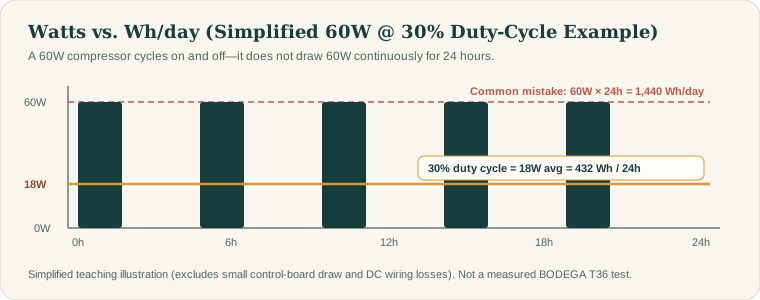
Simplified math illustration (not a measured T36 test)
Assume a 60W compressor runs at a 30% duty cycle (about 7.2 active hours in 24 hours):
- Average power:
60W × 0.30 = 18W - 24-hour energy:
18W × 24h = 432 Wh/day
This 432 Wh/day figure is a simplified teaching example, not a measured BODEGA T36 test. Real fridges also draw a small continuous trickle for the controller and fan, plus DC wiring or inverter losses.
Converting Wh to Ah—and why voltage matters
House batteries use amp-hours (Ah) while power stations use watt-hours (Wh) (Wh = Ah × V). A 432 Wh load equals 33.8 Ah at 12.8V LiFePO4 (432 ÷ 12.8), or 36.0 Ah at 12.0V nominal (432 ÷ 12.0). For an AGM battery limited to 50% usable depth of discharge, you would need roughly a 72 Ah battery for one day.
Real-world 12V fridge test examples and conditions
Published 24-hour tests beat nameplate watts when test conditions are clear. BODEGA Cooler’s published BD60 test (verified November 14, 2026) recorded:
- 70°F (21°C) ambient, 37°F (3°C) cabinet: 170 Wh / 24h (~7.1W average)
- 70°F (21°C) ambient, 0°F (-18°C) cabinet: 356 Wh / 24h (~14.8W average)
Important context: This is a manufacturer-published test on one model (BD60) at 70°F (21°C)—not an independent third-party lab test, and not representative of all models or a 105°F (41°C) parked SUV. Still, it shows that deep-freeze mode (0°F / -18°C) more than doubles daily draw versus fridge mode (37°F / 3°C).
What makes a 12V fridge use more power?
- Ambient heat: A shaded 70°F (21°C) camp kitchen sheds heat easily; a 95°F–110°F (35°C–43°C) closed car forces longer compressor cycles.
- Freezer or dual-zone setpoints: Holding 0°F (-18°C) takes roughly twice the energy of 37°F (3°C).
- Warm food loading: Chilling 75°F (24°C) drinks keeps the compressor in MAX mode for hours. Pre-chill on wall AC power before leaving.
- Frequent lid openings: Repeated snack breaks spill cold air and pull in humid air.
- Ventilation and AC vs. DC path: Keep vents clear and power via 12V DC instead of an AC inverter to avoid ~10%–15% conversion and idle losses.
How to measure your 12V fridge's actual daily power draw
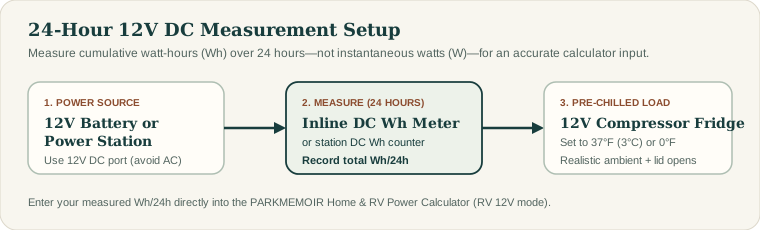
A 24-hour home test removes the guesswork:
- Pre-chill first: Stabilize the fridge on wall power at your trip setpoint (e.g., 37°F / 3°C) with water bottles inside.
- Connect a meter: Place an inline 12V DC watt-hour meter between your battery and fridge, or use your power station’s DC Wh counter.
- Run 24 hours: Keep the cooler near expected trip temperatures and open the lid a few times.
- Log total Wh/24h: Enter that cumulative Wh figure—not instantaneous watts—into the Home & RV Power Calculator.
How long will a 1kWh or 2kWh battery run a 12V fridge?
To keep runtime estimates consistent, start with usable Wh (~90% DC efficiency), divide by daily load for theoretical runtime, then apply a 25% planning margin (× 1.25) for conservative planning runtime (fridge-only, before lights or fans):
- 1,024 Wh (~1kWh) station (~922 Wh usable at 90% DC):
- At 170 Wh/day (mild 70°F test): ~5.4 days theoretical, or ~4.3 days conservative (with 25% margin).
- At 432 Wh/day (warm illustration): ~2.1 days theoretical, or ~1.7 days conservative.
- 2,048 Wh (~2kWh) station (~1,843 Wh usable at 90% DC):
- At 432 Wh/day: ~4.3 days theoretical, or ~3.4 days conservative—leaving room for a roof fan, LED lights, and phone charging.
For cold-weather trips, check lithium safe-charging temperature limits alongside park conditions in our Winter National Parks Planner. Then run your 1-, 2-, or 3-day numbers in the Home & RV Power Calculator (RV 12V mode).
Frequently asked questions
How many watts does a 12V fridge use per day?
A 12V compressor fridge typically draws 45W–60W while active and cycles off. As an illustrative planning range (not a measured value for every cooler), budget 170–500 Wh/day: BODEGA’s BD60 test at 70°F (21°C) recorded 170 Wh/24h at 37°F (3°C) and 356 Wh/24h at 0°F (-18°C).
How many amp hours (Ah) per day does a 12V fridge use?
Divide Wh/day by battery voltage: at 12.8V (LiFePO4), 170 Wh is ~13.3 Ah, 356 Wh is ~27.8 Ah, and 432 Wh is ~33.8 Ah (or 14.2 / 29.7 / 36.0 Ah at 12.0V nominal).
How long will a 1000Wh battery run a 12V fridge?
At 90% DC efficiency, a 1,024 Wh station provides ~922 Wh usable. Alone, that is ~5.4 days theoretical (~4.3 days conservative with a 25% margin) at 170 Wh/day, or ~2.1 days theoretical (~1.7 days conservative) at 432 Wh/day.
Why does a 60W 12V fridge not use 1,440 Wh per day?
60W is active running power, not a 24-hour average. At a 30% duty cycle, a 60W compressor averages 18W (432 Wh/day) before minor control-board and DC losses.
Estimate your battery size in the Home & RV Power Calculator
Enter your measured or estimated Wh/day, trip days, extra camp loads, and optional solar or alternator recharging.
Matching BODEGA 12V fridges and Anker SOLIX power stations
Size your energy requirement first—never pick a power station solely from a fridge’s liter capacity. Purchase buttons appear only for verified ASIN and PartnerBoost links.
Affiliate disclosure: PARKMEMOIR may earn a commission from verified PartnerBoost links below, at no extra cost to you. See our affiliate disclosure.
BODEGA 12V Fridge Comparison
| Model | Best For | ASIN | Availability |
|---|---|---|---|
| BODEGA T36 · 36L Dual-Zone 12V Fridge | Small families, dual zone | B0CL9Z9CK3 | Check price on Amazon |
| BODEGA T36-T · 36L Single-Zone 12V Fridge | Solo/couple, single zone | B0CJM5BMHQ | Check price on Amazon |
| BODEGA T50T · 53Qt Single-Zone 12V Fridge | Multi-day road trips | B08TRDQ5Y8 | Check price on Amazon |
| BODEGA T60 · 60L Dual-Zone 12V Fridge | Larger 60L dual zone | B0CYWPRC7X | Check price on Amazon |
Anker SOLIX Power Stations by Calculator Tier
Anker SOLIX C1000 Gen 2 + 200W Solar
ASIN B0GWGSKN54
Fits ~1kWh calculator estimates (typically 1–2 days of warm fridge use without recharging).
Check price on AmazonAnker SOLIX C2000 Gen 2 + 200W Solar
ASIN B0GYNV5T38
Fits ~2kWh calculator estimates with a 200W solar panel for sunny multi-day camps.
Check price on AmazonMore 2kWh & 4kWh Anker charging/expansion options
Anker SOLIX C2000 Gen 2 + Alternator Charger
ASIN B0FVFK7Z29
For high-mileage driving days after confirming vehicle alternator compatibility.
Check price on AmazonAnker SOLIX C2000 Gen 2 + Expansion Battery
ASIN B0FVFK7MHC
Only for multi-day loads exceeding 2,048 Wh after verifying compatibility and cargo weight.
Check price on Amazon